Does Viagra help psychological ED?
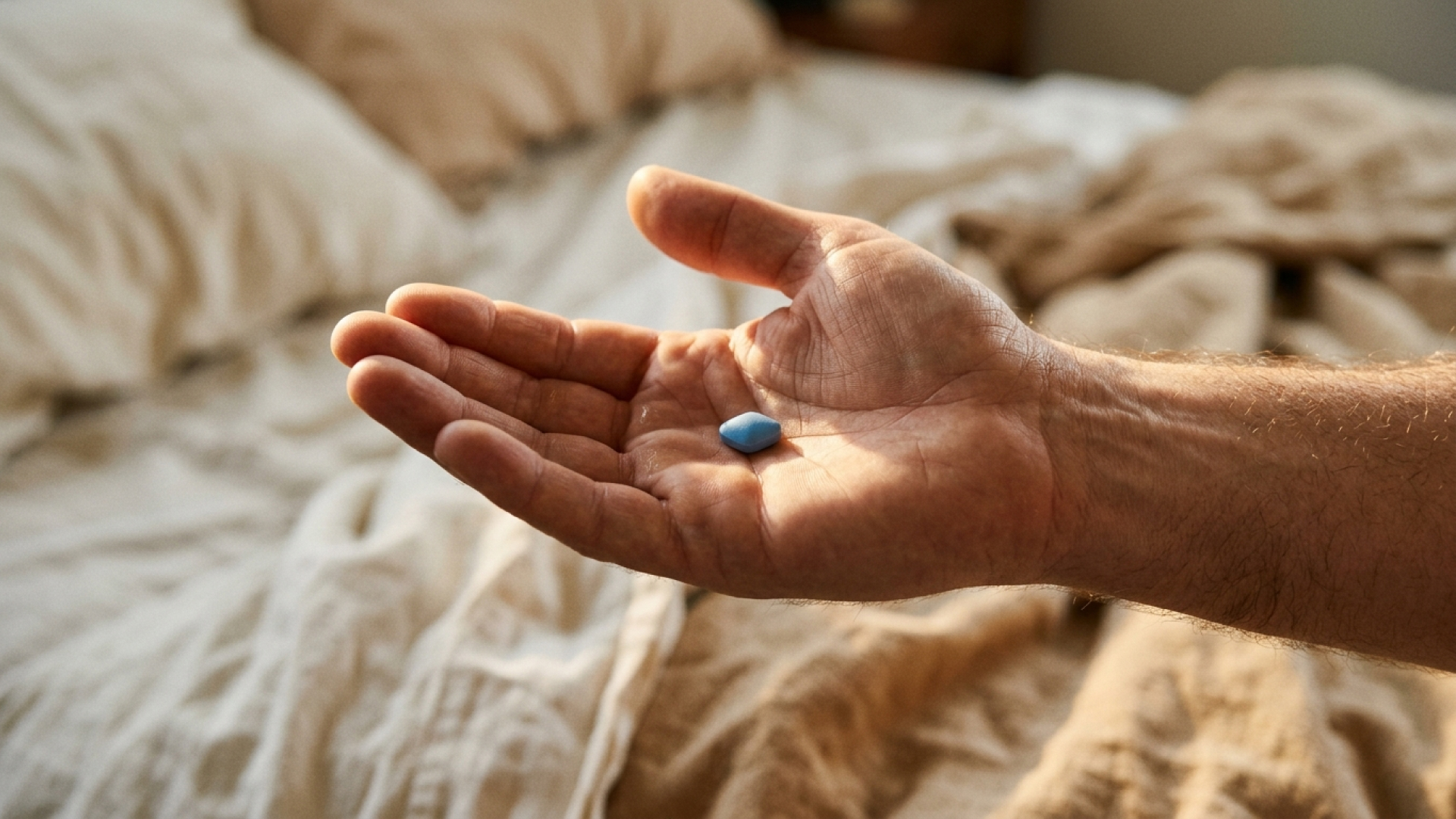

Viagra (sildenafil) can help psychological erectile dysfunction. It relaxes blood vessels and increases blood flow to the penis, which can make it easier to get and keep an erection despite anxiety or stress. However, psychological erectile dysfunction (ED) starts as a mental or emotional pattern, so sildenafil treats the physical symptom without addressing why the anxiety developed in the first place.
Some studies show that as many as 30% of men under 40 have experienced erection difficulties (Nguyen et al., 2017). In one clinic study of 948 men with ED in Turkey, 83% of men under 40 had mainly psychogenic ED, compared with 40.7% of men over 40 (Caskurlu et al., 2004).
Does Viagra actually work on psychological ED?
It can, for many men. Phosphodiesterase type 5 (PDE5) inhibitors like Viagra work on blood flow. That means they might still work when your erection issue is psychological, because the mechanism doesn't depend on what's happening in your head. They don't work for every physical cause of ED, though.
Erectile dysfunction (ED) covers any erection that doesn't work reliably enough for sex, whatever the cause behind it. Read our full guide to erectile dysfunction if you want the wider picture of ED as a category.
Men whose ED has a psychological side often report some of the same experiences:
- Morning erections still happen. Erections during sleep or on waking often carry on as normal.
- Erections alone feel different. Masturbation may be fine, while sex with a partner is harder.
- It started suddenly. The difficulty often lines up with a stressful event, a new partner, or one bad experience.
- It comes and goes. It may get worse with pressure, tiredness, stress, or after drinking.
These are only clues. Physical and psychological causes often show up together, and no single sign confirms or rules out either one. Guidance from the American Urological Association says that nighttime or morning erections suggest, but don't confirm, a psychological part to ED (Burnett et al., 2018).
Psychological ED can also take two forms. The general type can look like a lack of arousal or trouble with sexual closeness. The situational type is linked to a partner, to performance, or to distress (European Association of Urology, 2025).
To find the exact cause of your ED, see a doctor. A healthcare professional can run specific tests to help tell apart blood flow, hormonal, and psychological causes (European Association of Urology, 2025). Our guide to signs that might help tell if ED is physical or psychological could help you prepare for that conversation.
For a lot of young men, there's nothing wrong with their blood vessels, hormones, or nerves. The block is happening somewhere else, usually stress, self-consciousness, or fear of underperforming with a partner.
Sildenafil could still help in these cases. It doesn't need to know why an erection isn't happening to fix the mechanics of it. It removes the physical uncertainty that anxiety feeds on, which is often enough to get a man through a specific moment.
The anxiety-ED feedback loop, and where medication fits
Anxiety and psychological ED feed each other. A man worries he won't get hard, and the worry makes it harder. The next attempt then starts from dread instead of desire.
Each failed attempt adds to the story the brain is telling itself. That story gets harder to shake each time it repeats.
Sometimes, this pattern is called sexual performance anxiety. It's closely tied to how stress affects erections more generally, since stress hormones are also linked to sexual functioning.
Sildenafil can interrupt that loop at the physical link. If the mechanics work reliably, the anxious thought has less to grab onto, and the cycle has a chance to break.
A double-blind, placebo-controlled trial using the SEAR (Self-Esteem And Relationship) questionnaire found sildenafil produced significantly greater improvements in self-esteem, confidence, and relationship satisfaction than placebo (Althof et al., 2006). That is a measured effect on how men felt about themselves and their relationships.
Is Viagra's confidence boost just a placebo effect?
Only in part, at least for men whose ED has a physical side. A follow-up mediation analysis found that erection hardness itself accounted for roughly 44% of sildenafil's effect on confidence and roughly 46% of its effect on sexual relationship satisfaction (Althof et al., 2010). This might mean that the confidence gain mostly comes from the real, physical improvement in erection quality.
The study involved men with ED of mixed or physical (organic) causes, so its findings shouldn't automatically be applied to men whose ED is only psychological. Sildenafil can improve erections by boosting the body's natural response to sexual stimulation. How much it helps depends on the person and the factors behind their ED.
Psychological factors still matter. Confidence, expectations, and performance anxiety can shape sexual experiences, and better erections may help reduce anxiety over time.
However, this study doesn't show whether sildenafil's psychological benefits are bigger in men with purely psychological ED. It also doesn't show how much of those benefits come from a placebo response.
When medication becomes a crutch instead of a bridge
Relying on Viagra as the only coping tool, without addressing the pattern behind the anxiety, can make the underlying issue worse over time. Amanda Barge, a BACP- and COSRT-accredited psychosexual and relationship therapist, warns that leaning on medication without addressing what's underneath it can leave men stuck in the same pattern indefinitely.
If the pill fails once, for any reason, whether it's alcohol, tiredness, or a stressful day, the anxiety it was covering for can come back stronger. There's a new fear layered on top of the old one: what if the pill stops working too?
Sildenafil doesn't teach your nervous system anything, and it doesn't change the beliefs, stress, or conditioning that shut down arousal in the first place.
Plenty of men use Viagra sensibly and get real value from it, especially as a way to get back into a sex life without the pressure of a specific moment going wrong. Treat it as one part of the picture, especially if the anxiety underneath it hasn't changed since the first prescription.
Medical guidelines say the same. For men with mainly psychological ED, the American Urological Association says doctors should offer a referral to therapy, either instead of or alongside medication. Here's how the options compare.
| Approach | What it works on | What the guidelines say |
|---|---|---|
| Sildenafil (Viagra) | Blood flow, by boosting the body's natural erection response to sexual stimulation | Can be effective for psychological ED. Should be prescribed by a licensed healthcare professional. |
| Psychotherapy or psychosexual counseling | The anxiety, stress, and beliefs behind the erection issue | Doctors should offer a referral as an alternative to medication for mainly psychological ED. |
| Both together | The physical symptom and the pattern behind it | Therapy may help men use medication more effectively and, in time, stop needing it. |
Source: (Burnett et al., 2018)
Dr. Shannon Chavez, a licensed clinical psychologist, AASECT-certified sex therapist, and certified clinical sexologist, sees this pattern often in her work with men on performance anxiety. That’s why she worked with Mojo to create The Erection Reset program.
What The Erection Reset adds that a pill can't
The Erection Reset adds a structured way to work on the anxiety pattern, which a pill cannot do. Viagra can still be a useful short-term bridge while you work on that pattern, but lasting change comes from addressing why the anxiety developed in the first place.
Psychological erection difficulties are a system responding to stress, self-consciousness, or pressure. Like any conditioned response, that system can be retrained with the right approach.
That's the gap Mojo's The Erection Reset program is built to close. It's a structured, expert-led program that helps men understand the pattern behind their anxiety.
The program gives men tools to work through that pattern at their own pace, alongside medication if that's part of what works for them. It doesn't diagnose or treat any medical condition.
FAQs
Yes, indirectly. By making erections more reliable, it can reduce the physical uncertainty that performance anxiety latches onto. For a lot of men, that might be enough to break the immediate cycle in the moment. A healthcare professional can help work out which treatment works best for you.
Often. PDE5 inhibitors work on blood flow, so many men see a physical benefit even when the root cause is psychological.
One common clue is whether you still get erections during sleep or in the morning, but symptoms might overlap. Only a healthcare professional can tell the types of ED apart, because it takes specific tests. Read our full breakdown on signs that might help tell if ED is physical or psychological.
It can become a problem if it's the only tool you use. Used alongside work on the underlying pattern, and prescribed by a licensed healthcare professional, it can be one useful part of the plan.
Physical ED usually stems from a vascular, hormonal, or neurological cause. Psychological ED stems from stress, anxiety, or conditioning, with the physical wiring intact. Many real-world cases involve some of both at once, which is why a clean either/or answer is rare.
Sources
- Althof, S. E., et al. (2006). Sildenafil citrate improves self-esteem, confidence, and relationships in men with erectile dysfunction: Results from an international, multi-center, double-blind, placebo-controlled trial. Journal of Sexual Medicine, 3(3), 521-529. https://doi.org/10.1111/j.1743-6109.2006.00234.x
- Althof, S. E., Berner, M. M., Goldstein, I., Claes, H. I. M., Cappelleri, J. C., Bushmakin, A. G., Symonds, T., & Schnetzler, G. (2010). Interrelationship of sildenafil treatment effects on the physiological and psychosocial aspects of erectile dysfunction of mixed or organic etiology. Journal of Sexual Medicine, 7(9), 3170-3178. https://doi.org/10.1111/j.1743-6109.2010.01882.x
- Burnett, A. L., Nehra, A., Breau, R. H., Culkin, D. J., Faraday, M. M., Hakim, L. S., Heidelbaugh, J., Khera, M., McVary, K. T., Miner, M. M., Nelson, C. J., Sadeghi-Nejad, H., Seftel, A. D., & Shindel, A. W. (2018). Erectile dysfunction: AUA guideline. The Journal of Urology, 200(3), 633-641. https://www.auanet.org/guidelines-and-quality/guidelines/erectile-dysfunction-(ed)-guideline
- Caskurlu, T., Tasci, A. I., Resim, S., Sahinkanat, T., & Ergenekon, E. (2004). The etiology of erectile dysfunction and contributing factors in different age groups in Turkey. International Journal of Urology, 11(7), 525-529. https://doi.org/10.1111/j.1442-2042.2004.00837.x
- European Association of Urology. (2025). EAU guidelines on sexual and reproductive health: Management of erectile dysfunction. European Association of Urology. https://uroweb.org/guidelines/sexual-and-reproductive-health/chapter/management-of-erectile-dysfunction
- Nguyen, H. M. T., Gabrielson, A. T., & Hellstrom, W. J. G. (2017). Erectile dysfunction in young men: A review of the prevalence and risk factors. Sexual Medicine Reviews, 5(4), 508-520. https://doi.org/10.1016/j.sxmr.2017.05.004
Mojo aims to provide useful wellbeing resources to its users; however, you should not solely rely on opinions or advice available on the Website or given by the Community. Always seek advice from a qualified medical doctor or other healthcare professional before acting.
About the experts

A clinical psychologist and AASECT-certified sex therapist, Shannon counsels couples and helps men see erection issues as nervous system patterns, not defects.


A medical doctor and women's health educator, Rugilė helps women understand periods, pain, and intimate health without myth or stigma.






Help is available when you're feeling low – you don't have to suffer in silence. If you're in crisis or struggling to cope, find someone to talk to on Find a Helpline.